
Fresh Yeast vs Instant Yeast: What’s the Difference and Which Should You Use?
If you’ve ever stood in the baking aisle debating between fresh yeast and instant yeast, you’re not alone. Both do the same essential job - helping dough rise - but they behave quite differently in practice. Understanding those differences can take your baking from hit-and-miss to consistently excellent.

What is Fresh Yeast?
Fresh yeast (also called cake yeast or compressed yeast) comes in soft, crumbly blocks. It’s alive and active, with a high moisture content, and has a short shelf life - usually just a couple of weeks in the fridge.
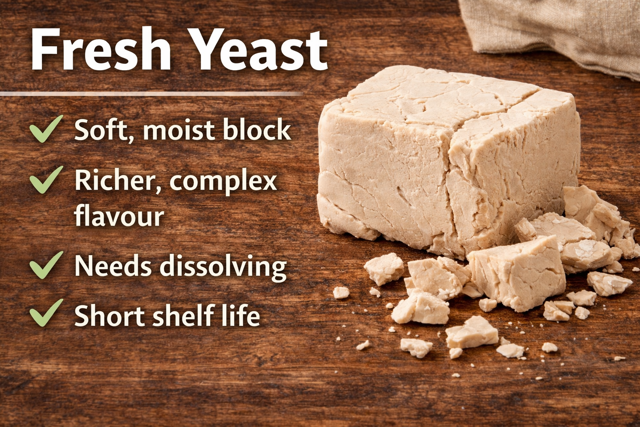
It’s often favoured by professional bakers for its subtle, slightly richer flavour and reliable fermentation when handled properly.
Pros:
Adds a deeper, more complex flavour to bread
Activates quickly when dissolved
Preferred for traditional and artisan baking
Cons:
Very short shelf life
Needs refrigeration
Can be harder to find in supermarkets
What is Instant Yeast?
Instant yeast (sometimes labelled “fast-action” or “quick-rise”) is dried yeast that has been processed into fine granules. It’s designed for convenience - you can mix it straight into your flour without needing to activate it first.

Pros:
Long shelf life (months or even years if unopened)
No need to proof before use
Consistent and reliable for most recipes
Cons:
Slightly less complex flavour compared to fresh yeast
Can lead to faster rises, which sometimes means less flavour development if you’re not careful
Key Differences at a Glance
Feature | Fresh Yeast | Instant Yeast |
Form | Soft, moist block | Dry granules |
Shelf life | Short (refrigerated) | Long (pantry-friendly) |
Preparation | Needs dissolving | Mix directly into flour |
Flavour | Richer, more nuanced | Mild, clean |
Rising speed | Moderate | Faster |
Can You Substitute One for the Other?
Yes—but you need to adjust quantities.
A simple rule of thumb:
Fresh yeast = 3x instant yeast
So if a recipe calls for 10g of fresh yeast, you’d use about 3 - 4g of instant yeast.
Tips for Using Fresh Yeast
Check freshness first: It should smell slightly sweet and yeasty, not sour or off.
Dissolve properly: Mix it with lukewarm water or milk (not hot) to activate it evenly.
Use it quickly: Don’t let it sit in the fridge for weeks - it loses strength fast.
Perfect for slow fermentation: Ideal for recipes where you want to develop flavour over time.

Tips for Using Instant Yeast
Mix it straight in: No need to bloom it - just add to your flour.
Control the rise: Because it works quickly, consider reducing the amount slightly if you’re doing a long proof.
Store it well: Keep it in an airtight container once opened to maintain potency.
Great for beginners: It’s forgiving and consistent, making it ideal if you’re new to baking.
Which Should You Choose?
It depends on what you value most:
Go for fresh yeast if you’re chasing flavour, baking traditional recipes, or want more control over fermentation.
Choose instant yeast if you want convenience, reliability, and something that’s always ready in your cupboard.

For most home bakers, instant yeast is the practical choice. But if you’re experimenting with artisan loaves or enriched doughs like brioche, fresh yeast can give you that extra edge.
Final Thought
There’s no “better” yeast - just the right one for your baking style. The real difference comes down to how much time you want to invest and the kind of flavour you’re aiming for. Try both and see which suits your kitchen - it’s one of the easiest ways to level up your bread game.

Comments